10 Places Along the Nile in Egypt You Should Visit

The Nile is one of the best ways to explore Egypt beyond Cairo and the famous Red Sea resorts. Along its banks, you’ll find ancient temples, historic towns, traditional markets and some of Egypt’s most interesting places to visit.
Whether you’re planning a Nile cruise or exploring the country independently, here are 10 places along the Nile worth adding to your Egypt itinerary.
10 Places Along the Nile in Egypt
The places are listed from north to south. Not all of them are Nile cruise stops. A Luxor to Aswan cruise usually stops at Edfu and Kom Ombo, and often at Philae in Aswan.
Cairo, Giza, Minya, and Asyut are not part of that cruise, and Abydos and Dendera are usually day trips from Luxor.
A few longer cruises of about 10 to 15 days start in Cairo and also stop at Minya, Asyut, Abydos, and Dendera on the way to Luxor and Aswan, but most ships only sail between Luxor and Aswan.
1. Cairo
Cairo is Egypt’s capital and a busy, loud city where the old and the modern parts sit side by side. You can try local street food, walk through the markets, and experience Egyptian hospitality.
I recommend visiting the old part of Cairo and Khan el-Khalili market. You can buy beautiful souvenirs there.

If the main streets feel too crowded, try the quieter side streets. You will find small coffee shops, bookstores, and places for a local breakfast.
For a break from the noise, go to the Nile embankment and watch the feluccas, the traditional sailing boats, on the water. The Egyptian Museum in Tahrir Square is still open too, but it now displays a smaller part of Egypt’s collection.
2. Giza
Giza is right next to Cairo, and it is home to the Great Pyramid and the Sphinx. Seeing the pyramids in real life is an unforgettable experience, and a must when you are in Egypt.
They have a special energy that I could feel when I was there. You can ride a camel at sunset, see the pyramids up close, visit some of the smaller tombs on the plateau, and learn about the history.

The Grand Egyptian Museum is also in Giza, about 2 km from the pyramids. It has been fully open since November 2025. The main highlights are the Tutankhamun collection, the huge statue of Ramses II in the entrance hall, and the Khufu boats.
Plan 3 to 4 hours for it. Tickets are sold online with a time slot, so book ahead and check the official website for the current rules.
➡️Book a tour from Cairo to the Giza Pyramids here
3. Minya
Minya is in Middle Egypt, between Cairo and Luxor, and it is visited much less than the main sights. The main reason to come is the tombs of Beni Hasan, about 20 km south of the city.
These rock-cut tombs are from the Middle Kingdom, and their walls are painted with scenes of daily life.
Two other places are worth a stop. Tuna el-Gebel was the necropolis of ancient Hermopolis, and it has catacombs and tombs. Tell el-Amarna, almost 60 km south of Minya, has the ruins of Akhetaten, the capital built by Pharaoh Akhenaten.
Minya is not on the standard Luxor to Aswan cruise. Only the longer cruises from Cairo stop here. Most people visit with a driver or a guided tour, and the facilities are basic compared with Luxor or Aswan.
Some operators offer day trips from Cairo, but you will spend a lot of time on the road.
4. Asyut
Asyut is a big modern city that most tourists skip. It has a mix of ancient Egyptian and Coptic Christian history.
On the west bank, you can visit the Tombs of Meir, where the governors and priests of ancient Cusae were buried. Asyut is also known for its Coptic monasteries.
Deir al-Muharraq, about an hour’s drive northwest of the city, is a pilgrimage site, and many believe the Holy Family stayed there longer than anywhere else in Egypt. Another monastery, Deir Dronka, is built near a cave where the Holy Family is said to have taken refuge.
Like Minya, Asyut is not on the standard Luxor to Aswan cruise, but the longer cruises from Cairo stop here. Many land tours combine the two cities.
5. Abydos
Abydos is one of Egypt’s most important archaeological sites, and it was a place of pilgrimage for ancient Egyptians. The main sight is the Temple of Seti I, which was finished by his son Ramses II.
Look for the hypostyle hall, the detailed reliefs, and the Abydos King List, a wall carving that lists 76 pharaohs. At the back of the temple is the Osireion, a structure thought to represent the symbolic tomb of the god Osiris.
Abydos is about 3 hours by road from Luxor. Most people see it as a day trip from Luxor together with Dendera, which makes a long day of around 10 hours, with a lot of driving.
6. Dendera
Dendera is home to the Temple of Hathor, one of the best-preserved temples in Egypt. Inside, 24 columns topped with the face of the goddess Hathor hold up a blue ceiling painted with astronomical scenes.
Restoration work has removed the old soot from the ceiling paintings, so the colors are easier to see.

You can usually go down into the crypts and up to the roof, but access can change, and some parts need an extra ticket. Ask at the ticket desk.
On the roof, a small chapel of Osiris has a copy of the famous Dendera zodiac on its ceiling. The original was removed in the 1820s and is now in the Louvre in Paris.
A trip to Dendera alone takes about 5 hours from Luxor, with around 3 hours of driving, depending on traffic.
7. Luxor
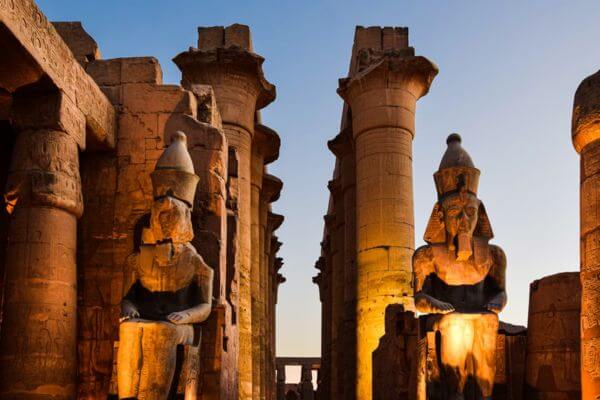
Luxor has many ancient sites, so give it a few days if you can. Most Luxor to Aswan cruises start or end here.
On the West Bank, the Valley of the Kings is where many pharaohs were buried in rock-cut tombs, including Tutankhamun. The Temple of Hatshepsut at Deir el-Bahari is a separate site, on the other side of the cliffs.
It is a mortuary temple, built for Hatshepsut, one of the few women to rule Egypt as pharaoh. It has three terraces with colonnades, built into the limestone cliffs.

Most West Bank tours include the Valley of the Kings, the Temple of Hatshepsut, and the Colossi of Memnon. Go early if you can, because it is cooler and there are fewer groups.
On the East Bank, you can visit the huge Karnak Temple and the Luxor Temple. Luxor Temple is especially nice at sunset.
8. Edfu
The Temple of Horus in Edfu is one of the best-preserved ancient temples in Egypt. Its walls are covered with carvings that tell mythological and historical stories. It was built in the Ptolemaic period.

Edfu is a regular stop on Luxor to Aswan cruises, and many cruises take a horse carriage from the boat to the temple. If you travel by road between Luxor and Aswan, you can stop at Edfu and Kom Ombo on the way.
9. Kom Ombo
Kom Ombo has a double temple, with one half for Sobek, the crocodile god, and the other half for Haroeris (Horus the Elder), the falcon god. The two halves mirror each other.
The temple combines Ptolemaic and Roman styles, and it stands right on the Nile, so the river view is part of the visit. Inside, you can see carvings and reliefs on the walls.

Outside, there is the temple well and a small pool where sacred crocodiles were kept.
The Crocodile Museum is right next to the temple. It opened in 2012 and shows mummified Nile crocodiles, the biggest of them 4.3 meters long. One ticket covers both the temple and the museum.
Kom Ombo is about 45 km north of Aswan. Cruise boats dock on the riverbank close to the temple, often in the afternoon or evening, and you can also reach it by road from Aswan.
10. Aswan
Aswan is the southernmost place on this list and the end point of most Luxor to Aswan cruises. It sits at the first cataract of the Nile, and Nubian culture is part of everyday life here.
The calm river with islands like Elephantine and Kitchener’s Island is nice for a felucca ride.
Philae Temple is the main temple to see in Aswan. It was built for the goddess Isis and stands on Agilkia Island, so you reach it by a short boat ride.
The temple was moved there stone by stone in the 1970s, a UNESCO project, because the Aswan High Dam would have flooded its original island.
You can also visit a Nubian village. Gharb Soheil on the West Bank is the one most visitors go to. You get there by motorboat or felucca, and the visit usually includes the colorful houses, tea with a local family, and a small market.

If you want to learn more about Nubian history, the Nubian Museum in Aswan is a good place to start.
Aswan is also the starting point for visiting Abu Simbel, but the temples are not actually in Aswan. The temples are about 280 km southwest, near the Sudanese border, so you need a separate trip.
By road it takes around 3 to 3.5 hours each way, and most tours leave very early in the morning. You can also take a short flight, about 45 minutes. Abu Simbel is not part of the standard Luxor to Aswan cruise.
Best Places Along the Nile: FAQs
Which of these places are on a Luxor to Aswan Nile cruise?
Most cruises stop at Edfu and Kom Ombo, and often at Philae in Aswan. You usually visit the sights of Luxor before or after the cruise.
Cairo, Giza, Minya, and Asyut are not part of it, but some longer cruises start in Cairo and stop at Minya, Asyut, Abydos, and Dendera on the way to Luxor.
Can you visit Abydos and Dendera from Luxor?
Yes. Most people do it as a day trip with a driver or a guide. Together it takes about 10 hours, with a lot of driving. If you are short on time, you can visit Dendera alone.
Is Abu Simbel on a Nile cruise?
Not on the standard Luxor to Aswan route. You visit it on a separate day trip from Aswan, about 3 hours by road each way, or you can take a short flight.
Is the Grand Egyptian Museum open?
Yes, it has been fully open since November 2025. Book your ticket online in advance and choose a time slot.
You might also want to check out: